Staff turnover is the most expensive and least discussed problem in the Indian hospitality industry. Estimates suggest that the average restaurant loses 40–60% of its floor staff annually — and each departure costs the business not just recruitment and training time, but service consistency and guest experience in the weeks it takes a new hire to get up to speed. The most reliable way to reduce turnover is to invest heavily in training at the start of every employment relationship.
Well-trained staff stay longer. They perform better. They upsell more confidently. They handle difficult guests with professionalism rather than anxiety. And they represent your brand accurately every time they step onto the floor. This guide gives you a practical, implementable framework for training every role in your venue — from servers and bartenders to kitchen staff and managers.
Why Training Is a Business Investment, Not a Cost
Many operators view training as a cost — time and money spent before a new hire is productive. The more accurate framing is that poor training is the cost, and structured training is the investment that pays it back multiple times over. Consider:
- Replacing a server costs an estimated ₹25,000–75,000 in India when you factor in recruitment, onboarding, and the management time required to rehire
- Untrained servers have lower average spend per cover — they do not upsell because they do not know the menu well enough
- Service inconsistency — which comes from inadequate training — drives negative reviews, which suppress future footfall
- Confident, knowledgeable staff create the guest experiences that generate word-of-mouth referrals
A structured training investment of 10–14 days per new hire is not a luxury; it is the minimum viable standard for a well-run venue.
5 Roles to Train Differently
Not all restaurant staff need the same training. Each role has distinct responsibilities, knowledge requirements, and guest-facing interactions. Here is how to differentiate your approach:
1. Servers and Floor Staff
The frontline of your guest experience. Training must cover menu knowledge (every dish, every ingredient, allergy information), service sequence (greeting, seating, ordering, timing of courses, billing), upselling language and technique, and handling complaints gracefully. Floor staff benefit most from role-playing exercises where they practise difficult scenarios — the rude guest, the wrong order, the long wait — before encountering them in real service.
2. Kitchen Team
Kitchen training focuses on standardisation: every dish must look and taste identical every time, regardless of who is on the line. This means written recipes with exact weights and plating specifications, mise en place standards, cooking timing for each dish, and clear communication protocols between front-of-house and kitchen. Kitchen staff also need thorough FSSAI food safety and hygiene training — this is both a compliance requirement and a quality imperative.
3. Bar Team
Bartenders need product knowledge that goes beyond mixing technique: the origin and flavour profiles of every spirit you stock, the construction logic behind your cocktail menu, upselling from house pours to premium spirits, and responsible service practices (identifying over-serving situations). If you have a significant beverage programme, consider an internal certification process before staff serve independently.
4. Host and Captain
Your host is the first and last impression every guest has of your venue. Training here is about emotional intelligence as much as process knowledge: reading a guest's mood at the door, managing waitlists without creating frustration, handling reservation disputes diplomatically, and ensuring the flow of guests through the venue supports table turnover targets. A great captain coordinates the floor like a chess player — always two moves ahead.
5. Restaurant Manager
Managers need operational training across every function — including the technical aspects of roles they supervise. They also need specific training in: reading and interpreting POS reports, managing labour costs and scheduling, conducting performance reviews, handling HR situations, and vendor management. Managers who have risen through the ranks often need formal training in areas they skipped on the way up.
The 3-Phase Onboarding Model
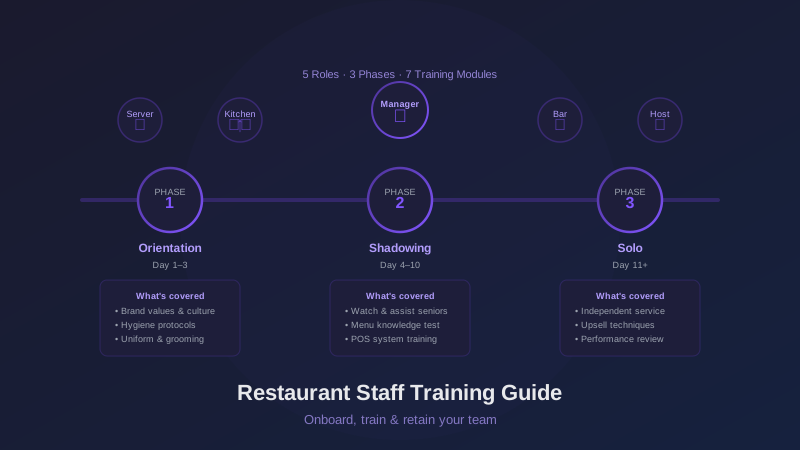
The most effective restaurant training programmes use a structured three-phase model. Rushing any phase is a false economy — it simply means re-training sooner, or tolerating substandard performance indefinitely.
Phase 1: Orientation (Days 1–3)
Orientation is about context before competency. Before a new hire can learn how to do the job, they need to understand why the job matters — your brand story, the experience you are trying to create, and the values that guide every interaction at your venue. Day one covers:
- Brand overview: your concept, history, positioning, and target guest
- Team structure and key contacts
- House rules: uniform standards, phone policy, punctuality expectations, code of conduct
- Hygiene and safety protocols — including a basic FSSAI food handling overview
- Venue tour: every section of the restaurant, kitchen, bar, storage, emergency exits
- Introduction to POS system (initial orientation — full training comes in Phase 2)
Phase 2: Shadowing (Days 4–10)
Shadowing is structured observation followed by assisted practice. New hires are paired with an experienced team member — ideally a designated trainer, not just whoever is available — and follow them through full service shifts. The progression should be deliberate:
- Days 4–6: Observe only — shadow the trainer through full service without interaction
- Days 7–8: Assisted service — take orders and serve tables with the trainer present
- Days 9–10: Menu knowledge assessment — written or verbal test on all dishes, allergens, and specials
During this phase, POS training should be conducted in detail — ideally through a practice mode or dummy orders before live service. This is where platforms with intuitive, touchscreen interfaces significantly reduce training time.
Phase 3: Solo with Check-ins (Day 11 onwards)
The new hire runs their own section independently, but with structured daily check-ins for the first two weeks. A manager or senior team member reviews their performance at the end of each shift — what went well, what they struggled with, specific improvement areas. Set a 30-day performance review to formalise feedback and confirm whether additional training is needed in any area.
Trainer certification: Designate two or three experienced team members as official trainers — and compensate them for the responsibility. Ad hoc training by whoever is available produces inconsistent results. Certified trainers also creates a career development pathway that improves retention.
7 Training Modules Every Restaurant Needs
Module 1: Menu Knowledge
Every team member who interacts with guests must know every item on the menu — ingredients, preparation method, flavour profile, portion size, and allergen information. Run a formal assessment at the end of Phase 2. Update this module every time the menu changes.
Module 2: Service Standards and Sequence
Document your service standards in writing. This includes: greeting language, table setting specifications, order-taking protocol, pacing of courses, checking back after food arrives, and closing the meal. Service standards should not exist only in the head of the most senior server — they should be a written, teachable document.
Module 3: POS and Billing System
A staff member who is slow on the POS creates friction at every stage of the guest experience — from taking orders to processing the bill. Invest time in POS training during the shadowing phase. Systems like ZillOut are designed to be intuitive for hospitality staff — with guided ordering flows, quick modifier selection, and one-tap split-bill functionality — which significantly cuts the time new staff need to reach full proficiency.
Module 4: Hygiene and FSSAI Standards
All food-handling staff must be trained in FSSAI food safety standards — this is a legal compliance requirement. Cover: personal hygiene, proper food storage temperatures, cross-contamination prevention, cleaning and sanitisation schedules, and what to do if a guest reports a food safety concern. Document this training and retain records — they may be requested during FSSAI inspections.
Module 5: Upselling Technique
Upselling is a skill, not a personality trait. Train your staff with specific language frameworks: open-ended questions ("Have you tried our new cocktail menu?"), benefit-led suggestions ("The lamb chops tonight are exceptional — they have been slow-braised for eight hours"), and pairing recommendations that feel like service rather than sales. Role-play this with the training team until the language feels natural.
Module 6: Conflict Resolution and Complaint Handling
How your staff handle a complaint determines whether a dissatisfied guest leaves to write a negative review or leaves as a loyal fan of your venue. Train a simple framework: Listen fully without interrupting, Acknowledge the guest's experience, Apologise sincerely (without admitting fault on every detail), Act (offer a resolution), and Follow through. The first response to a complaint should never be defensive — it should be empathetic.
Module 7: Emergency Procedures
Every team member should know: fire evacuation routes, location of fire extinguishers, basic first aid procedures for choke and burn incidents, the process for calling emergency services, and what to do if a guest has a severe allergic reaction. Run a fire drill at least twice a year and ensure all new staff complete emergency training in their first week.
How to Measure Training Effectiveness
Training without measurement is hope. Quantify outcomes at 30, 60, and 90 days after a new hire joins:
- Average spend per cover — are trained servers upselling effectively?
- Guest satisfaction scores — Zomato/Swiggy ratings, Google reviews, table feedback
- Order accuracy rate — percentage of orders delivered correctly first time
- Retention rate — are trained staff still with you at 90 days, 6 months, 1 year?
- Training assessment scores — menu knowledge tests and service standard assessments
Common Mistakes Restaurant Owners Make with Staff Training
- "We'll figure it out on the job": The single most costly mistake. New hires thrown into service with minimal preparation make more errors, provide inconsistent service, and leave faster.
- Training once and never updating: Menu changes, new policies, new technology — training must be continuous, not a one-time onboarding event. Monthly all-hands briefings on new items and standards keep knowledge current.
- No written training materials: If your training materials exist only in the head of your most experienced server, your training programme is as fragile as that person's employment contract. Document everything.
- Ignoring soft skills: Operators often over-index on technical training (POS, menu knowledge) and under-invest in interpersonal skills (handling difficult guests, reading the floor, managing stress during peak service). Both matter equally.
- Not compensating trainers: If experienced staff are expected to train others as an informal add-on to their job, they will do it poorly. Formalise the trainer role and the associated pay.
Final Thoughts
The restaurants with the lowest turnover and the highest guest satisfaction scores share a common characteristic: they invest in their people from day one, and they never stop. Training is not a box to check before someone starts on the floor — it is a continuous commitment that pays back in loyalty, consistency, and commercial performance.
Build your three-phase onboarding programme, document your seven training modules, and designate certified trainers. Then use technology to support the process — tools like ZillOut make POS training faster and billing simpler, which frees your team to focus on the human side of hospitality that no system can replace.