Your menu is not just a list of food and drinks — it is your single most powerful sales tool. Every item placement, every price point, every word of description is an opportunity to guide a guest toward a higher-margin choice. That is the core promise of menu engineering: using data and psychology together to design a menu that works harder for your business.
Pioneered by Cornell University researchers in the 1980s, menu engineering has become a discipline practised by the world's most profitable restaurant groups. In India, where margins are tight and competition fierce, it is a skill every venue owner and F&B manager needs to master. This guide walks you through the framework, the psychology, and seven actionable steps you can apply this week.
What Is Menu Engineering?
Menu engineering is the systematic analysis and design of a restaurant menu to maximise profitability and popularity of dishes. It sits at the intersection of food costing, consumer psychology, and graphic design. The goal is simple: encourage guests to order the items that are both popular and high-margin.
At its heart, menu engineering uses two variables for every item on your menu:
- Contribution Margin (CM): Selling price minus food cost — the actual rupee profit per item sold.
- Popularity: How frequently the item is ordered relative to other items in the same category.
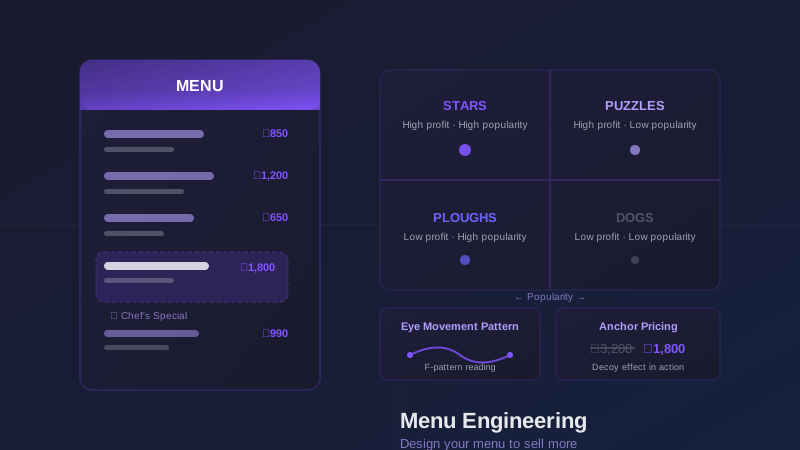
Plotting every dish on these two axes gives you the four-quadrant model that is the foundation of all menu engineering work.
The Four-Quadrant Model: Stars, Ploughs, Puzzles, and Dogs
| Quadrant | Contribution Margin | Popularity | Strategy | Example |
|---|---|---|---|---|
| Stars | High | High | Protect and promote — keep pricing stable, highlight on menu | Signature cocktail, bestselling main course |
| Ploughs (Cash Cows) | Low | High | Popular but low-margin — gradually raise price or reduce portion | Butter chicken, classic biryani |
| Puzzles | High | Low | High margin but few orders — reposition, rename, or promote | Exotic salad, premium seafood dish |
| Dogs | Low | Low | Remove or reimagine — drain kitchen resources for little return | Rarely-ordered fusion dish with expensive ingredients |
How to calculate your categories: Run your POS sales report for the last 30–60 days. Calculate the food cost % and total orders for each item. Items with food cost below 30% and above-average order frequency are your Stars. Start there.
The Psychology of Menu Layout
How guests read your menu is predictable — and exploitable. Research consistently shows two key patterns:
The Eye Movement Pattern
In a two-page spread, guests' eyes naturally travel to the top-right corner first, then to the top-left, then down the centre. This is called the "golden triangle." In a single-column menu (common in Indian casual dining), the first and last items in each section receive the most attention. Place your highest-margin items in these positions.
Anchoring and the Decoy Effect
When guests see a ₹3,500 wagyu dish near the top of the menu, suddenly the ₹1,800 lamb chops seem reasonable. This is price anchoring — using an expensive item as a reference point to make mid-range items feel like good value. You do not need to sell many of the expensive anchor items; you just need them there to reframe perception.
The decoy effect works similarly: if you offer a small portion at ₹250 and a large at ₹350, most people choose the large — but introducing a "medium" at ₹320 makes the large feel even more justified.
7 Actionable Menu Engineering Tips
1. Limit Choices to Reduce Decision Fatigue
Research from Columbia University found that too many options paralyse customers. The optimal number of items per category in a restaurant menu is 7 ± 2. If your menu has 40 starters, you are overwhelming your guests and diluting focus from your star items. Audit and cut ruthlessly — fewer, better items increase both satisfaction and average spend.
2. Use Descriptive, Sensory Language
Studies show that menu items with descriptive names outsell their plainly named counterparts by up to 27%. Compare "Grilled Chicken" versus "Smoky Tandoor Chicken, slow-marinated in hung curd & Kashmiri spices, served with mint chutney." The second version activates sensory imagination and justifies a higher price. Use origin stories, cooking techniques, and flavour adjectives — but keep it truthful.
3. Anchor Prices Strategically
Place your highest-priced item at the top of each section. This is not the item you expect to sell most — it is there to make everything below it feel reasonably priced. Ensure the gap between your anchor and your next-most-expensive item is noticeable but not jarring.
4. Highlight High-Margin Items Visually
Use boxes, shading, icons (a "Chef's Special" star or flame icon), or larger font to draw the eye to your Stars and Puzzles. On a printed menu, never highlight more than two or three items per section — exclusivity is the point. On a digital menu, pinned or featured items at the top of a category work the same way.
5. Remove Currency Symbols
This one is well-documented: listing prices as "1,200" instead of "₹1,200" reduces price sensitivity. The rupee symbol is a mental trigger that activates the "loss" area of the brain. In upscale dining environments, removing currency symbols — or writing prices in words — measurably increases average spend per cover.
6. Rotate Seasonally and Test Continuously
A menu that never changes tells guests you are not evolving — and it prevents you from capitalising on seasonal ingredient pricing. Aim for at least a quarterly menu review: retire Dogs, test new items in the Puzzle quadrant, and consider running A/B price tests on Ploughs (raise by ₹50 and see if order frequency drops). Good menu engineering is never a one-time exercise.
7. Digital vs Print: Different Rules Apply
A printed menu gives you full control over layout, typography, and placement. A digital menu — whether QR-code-based or on a tablet — follows different browsing behaviour. Guests scroll rather than scan two pages simultaneously. This means your first item in each category carries even more weight on digital. Platforms like ZillOut allow you to pin featured items, add photos to star dishes, and update pricing or descriptions instantly — without the cost and delay of a reprint. If you are running dynamic pricing by time of day (higher margins during peak hours), digital menus make this operationally feasible.
Pro Tip: Add high-quality photography for your top three or four items only. Menus with photos on every item feel budget. Selective photography on your Stars and Puzzles signals quality and draws attention exactly where you want it.
Putting It All Together: A Menu Engineering Workflow
Here is the practical sequence to run a menu engineering exercise at your venue:
- Extract data: Pull 60 days of item-level sales from your POS. Include quantity sold and selling price.
- Calculate food cost per item: Work with your kitchen team to cost every dish accurately — ingredient cost, portion weight, wastage allowance.
- Plot the four quadrants: Calculate contribution margin per item. Flag items above or below average popularity.
- Prioritise actions: Stars → protect. Ploughs → test price increases. Puzzles → reposition. Dogs → remove or reimagine.
- Redesign layout: Apply eye-movement principles, pricing psychology, and visual hierarchy.
- Launch and measure: After 30 days, re-run the analysis. Track average spend per cover as your primary KPI.
Common Menu Engineering Mistakes in Indian Restaurants
- Too many categories: Appetisers, soups, salads, tandoor, curries, rice, breads, desserts, beverages, specials — that is nine categories before you even get to drinks. Consolidate where possible.
- Underpricing popular items: If your Dal Makhani sells 80 times a day but has a 40% food cost, you are working very hard for thin margins. Gradually test price increases — loyal guests rarely churn over a ₹30–50 increase.
- Ignoring beverage engineering: Beverages often have the highest contribution margins in the house. Apply the same rigour to your drinks menu — it is frequently left as an afterthought.
- Not training staff on the menu: Menu engineering only works when your team actively guides guests toward your Stars. Regular menu briefings and a structured upselling language are non-negotiable.
Final Thoughts
Menu engineering is one of the highest-return investments a restaurant can make — it costs nothing but time and analysis, and the upside is a measurable lift in revenue per cover without adding a single seat. Start with your top 20 items, plot the four quadrants, and make two or three targeted changes. The data will do the rest.
Your menu is never finished. The best operators treat it as a living document — constantly tested, refined, and optimised alongside every other lever in the business.