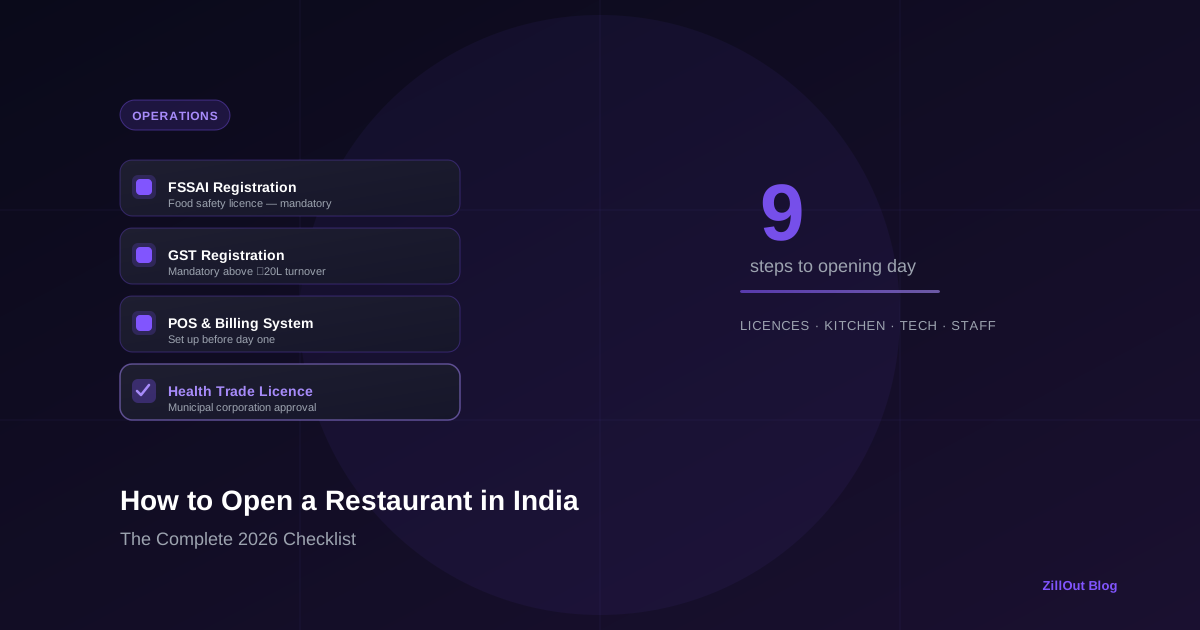
Why Most Restaurants Fail in India — and What This Checklist Solves
India's restaurant industry is one of the most exciting and most brutal business environments in the world. The restaurant business in India is valued at over ₹5.99 lakh crore and growing at 9% annually — yet industry estimates consistently show that 60–70% of new restaurants close within their first year. Most of those failures are not caused by bad food. They are caused by preventable operational and regulatory mistakes made before the doors ever open.
The three most common failure modes are: running out of working capital because pre-opening costs were underestimated, facing licence shutdowns because compliance was treated as an afterthought, and launching without operational systems — no POS, no inventory controls, no staff training — then haemorrhaging money as chaos sets in during service. Every single one of these is avoidable.
This checklist is designed for first-time restaurant owners as well as experienced operators opening a new location. Work through each step in order. Each section includes the specific actions, costs, and timelines you need to keep your project on track and open on time.
Step 1: Business Structure & Registration
Before you sign a lease, apply for a licence, or order a single piece of equipment, you need a legal entity. The business structure you choose affects your tax liability, ability to raise capital, personal liability exposure, and how you can eventually scale or exit the business.
Sole Proprietorship is the simplest structure — no formal registration beyond a bank account in your business name and FSSAI. All income flows through your personal tax return. It is fine for a single small outlet run entirely by you, but it offers zero personal liability protection and makes it nearly impossible to bring in a co-investor or take a business loan at scale.
Private Limited Company (Pvt Ltd) is the recommended structure for any restaurant with ambitions to grow beyond one location or bring in investors. Registration costs approximately ₹6,000–₹10,000 in government fees and takes 7–15 working days through the MCA portal. You will need a minimum of two directors and one lakh rupees in authorised capital. The company is a separate legal person — your personal assets are protected even if the business fails.
Partnership Firm or LLP sits in between — useful when two or more founders are involved but the overhead of a Pvt Ltd feels premature. A Limited Liability Partnership (LLP) registered under the LLP Act 2008 offers personal liability protection similar to a Pvt Ltd with fewer compliance requirements.
Regardless of your structure, GST registration is mandatory once your aggregate turnover exceeds ₹20 lakh (₹10 lakh in special category states). Most restaurants cross this threshold quickly. Apply on the GST portal — the process takes 3–7 working days and is free. Your GST registration certificate will be required for your FSSAI application, bank account, and landlord agreements. Restaurant services attract 5% GST (without input tax credit) for most dine-in outlets. Confirm your applicable rate with a CA before filing.
Step 2: Location & Premises
Location is not just about footfall — it is about lease terms, space configuration, and regulatory permissions that will define your cost structure for years. A good location with a terrible lease will kill your business as surely as a bad location.
Lease terms to negotiate hard on: Lock-in period (aim for a 3-year lock-in on a 9-year lease, not a 5-year lock-in), rent escalation clause (cap at 5% annually or tie it to CPI), fit-out free period (6 months minimum — the time you spend building out the space before you open), security deposit (market is 6–10 months rent in metro cities; push for 3–6), and a clear exit clause that defines how you restore the space at the end of the lease.
Carpet area minimums: A viable café or QSR can operate in 400–600 sq ft of carpet area. A casual dine-in restaurant needs a minimum of 800–1,200 sq ft to accommodate a kitchen, prep area, wash station, and dining room that generates sufficient covers. Fine dining with full kitchen and private dining capability typically requires 2,000 sq ft or more. Understand that roughly 35–45% of your total area will be dedicated to the back of house — the kitchen, pantry, cold storage, and staff areas.
Kitchen layout principles: A well-designed commercial kitchen follows a linear or galley flow — ingredients in, prep, hot cooking, plating, and service in a logical sequence without cross-traffic. Ensure your space can accommodate a 4-burner or 6-burner commercial range, a working cold room or chest freezers, adequate worktop space, a separate prep sink and wash station, and proper exhaust ducting. Have a professional kitchen designer review your floor plan before you finalise your fit-out contractor — bad kitchen design is almost impossible to fix once the gas lines and exhaust are in.
A Fire NOC (No Objection Certificate) from your local fire department is mandatory before your FSSAI and Eating House Licence will be issued. The Fire Department will inspect your premises for fire exits, fire extinguishers, emergency lighting, and (for spaces above 300 sq ft) sprinkler systems. Build the fire safety requirements into your fit-out from the beginning — retrofitting sprinklers or fire doors is expensive and causes delays.
Step 3: Licences & Compliance
Getting your licences right is the single most underestimated part of opening a restaurant in India. First-time owners routinely underestimate both the number of licences required and the time each one takes. Start your applications on day one of your lease — not week four.
FSSAI Licence is the most important licence for any food business. The Food Safety and Standards Authority of India requires all food businesses to be registered or licensed before they start operations. Most restaurants will need an FSSAI State Licence (for annual turnover between ₹12 lakh and ₹20 crore), which costs ₹2,000–₹5,000 per year depending on the state and takes 30–60 days to process. Apply at foscos.fssai.gov.in. You will need your premises proof, business registration documents, a list of food categories you will handle, and a food safety management plan. Note: operating without a valid FSSAI licence can result in fines of up to ₹5 lakh and closure.
Shop & Establishment Act Registration is required under each state's specific Act (e.g., the Maharashtra Shops and Establishments Act or the Tamil Nadu Shops and Establishments Act). This registration regulates working hours, holidays, and employment conditions. Application is made to the local Labour Department or municipal authority, costs ₹125–₹1,000 depending on the number of employees, and is typically processed within 7–15 days. You need this before you hire your first employee.
Health Trade Licence is issued by your local municipal corporation (BBMP in Bangalore, BMC in Mumbai, MCD in Delhi) and certifies that your premises meets public health standards. The licence requires an inspection of your kitchen, sanitation facilities, and waste disposal arrangements. Fees range from ₹1,000–₹10,000 depending on the city and restaurant size. Renewal is annual. In many municipalities, you cannot get your FSSAI licence without this.
Eating House Licence is mandatory in several states including Maharashtra, Delhi, and Karnataka. In Delhi, it is issued by the Delhi Police; in Maharashtra, by the local police commissioner's office. The application requires your lease, fire NOC, and other trade licences. Processing time is 30–90 days — this is often the longest licence to obtain, so apply for it first.
Liquor Licence — if you intend to serve alcohol, this is an entirely separate regulatory track. State Excise Departments govern liquor licensing, and rules vary enormously: from relatively accessible in Goa to extremely complex and expensive in Tamil Nadu (where private bars are prohibited in most areas) or Gujarat (which is a dry state). Liquor licences in metro cities like Mumbai or Delhi can cost ₹5–25 lakh annually and take 3–6 months to process. Budget, timeline, and feasibility will depend entirely on your state — engage a local licensing consultant early.
Additional compliance: If you have background music in your restaurant, you need a Phonographic Performance Limited (PPL) licence and an Indian Performing Right Society (IPRS) licence. Combined, these cost approximately ₹5,000–₹15,000 per year depending on your seating capacity. Playing recorded music without these licences is a copyright violation.
Step 4: Kitchen Setup & Equipment
Your kitchen is your production facility. Cutting corners here is one of the most expensive mistakes a restaurant owner can make — cheap domestic appliances fail under commercial use within months, and replacing equipment during service is disruptive and costly.
Every restaurant kitchen needs these essentials regardless of cuisine type:
- Commercial range/burners — A 4-burner commercial range starts at ₹15,000; a 6-burner with oven starts at ₹35,000. Buy commercial grade, not domestic.
- Exhaust and ventilation — A properly sized exhaust hood, duct, and exhaust fan. This is non-negotiable for fire safety compliance and for your staff's working conditions. Budget ₹40,000–₹1.5 lakh depending on kitchen size.
- Refrigeration — A commercial refrigerator (2-door, 500L) costs ₹25,000–₹40,000. You will also need a deep freezer for proteins (₹12,000–₹20,000) and a display fridge for beverages if applicable.
- Prep equipment — Commercial mixer-grinder (₹8,000–₹20,000), food processor, vegetable chopper, and a dough sheeter if you bake. Match equipment to your specific menu.
- Worktops and storage — Stainless steel tables and racks are the standard. Budget ₹15,000–₹40,000 for fabricated SS worktops and wall shelving.
- Cooking vessels and small equipment — Kadais, stock pots, gastronorm containers, ladles, tongs, spatulas, strainers, cutting boards (colour-coded by food type per HACCP standards), and a set of calibrated measuring tools. Budget ₹15,000–₹30,000.
- Wash station — A three-compartment sink (wash, rinse, sanitise) is the food safety standard. Add a commercial dishwasher if your cover count warrants it (₹80,000–₹2 lakh for a rack-type machine).
- Fire suppression — CO2 or dry chemical extinguishers placed per fire department specifications, plus a kitchen hood suppression system if your cooking load is heavy. This is a regulatory requirement, not optional.
Total kitchen setup costs for a 50-cover casual restaurant typically range from ₹8–15 lakh, not including the fit-out, plumbing, or electrical work required to support the equipment. Get three quotes from kitchen fabrication vendors and check references before committing.
Step 5: Menu Development
Your menu is your most important financial document. Every item on it is a decision about food cost, labour cost, equipment utilisation, and brand positioning. Restaurants that build their menus around what they love to cook — without running the numbers — routinely discover they are selling dishes at a loss.
Recipe costing is non-negotiable before you print a single menu. For every dish, list every ingredient, the quantity used per portion, and the cost per unit. Sum it up to get your raw material cost per dish. Your food cost percentage is this number divided by the selling price, expressed as a percentage. For a financially healthy restaurant in India, target:
- QSR and fast casual: 25–30% food cost
- Casual dine-in: 28–35% food cost
- Fine dining: up to 38% food cost (offset by higher average spend)
If a dish you want on the menu cannot be priced within these parameters at a price your target customer will accept, remove it or rework the recipe. Common adjustments include switching to seasonal produce, reducing portion weight by 10–15%, or replacing expensive proteins with more cost-efficient alternatives.
Menu engineering: Categorise every dish on your final menu as a Star (high profit, high popularity), Plough Horse (high popularity, low profit), Puzzle (high profit, low popularity), or Dog (low profit, low popularity). Stars deserve prominent placement. Dogs should be removed. Plough Horses need recipe adjustments to improve margins. Puzzles need better merchandising and description writing.
Keep your opening menu focused — 30–40 items maximum for a casual restaurant. A focused menu reduces inventory complexity, training time, and food waste. You can always expand after you understand your customer's preferences. Most successful restaurateurs say their best menu was their third one, after they stripped out everything that did not sell.
Step 6: Technology & POS Setup
Technology decisions made at launch are extremely hard to change later. Your point-of-sale system, digital menu, reservation platform, and billing software will shape how your team works every day. Setting these up correctly from day one — before you are in the middle of a busy service — is one of the highest-leverage things you can do as an owner.
A POS system is not optional, even for a small restaurant. Running on paper KOTs or a basic billing app creates blind spots that cost you money: missed orders, incorrect bills, theft by staff, and zero data for making menu or staffing decisions. A cloud-based POS designed for Indian restaurants handles GST-compliant billing, KOT printing, table management, inventory depletion, and daily reports — and integrates directly with Zomato and Swiggy if you take delivery orders.
ZillOut Grey is built specifically for restaurants that want POS, digital menus, and reservations in a single integrated platform. Rather than stitching together three different software subscriptions, Grey gives you a unified system where every order, every table booking, and every guest interaction feeds into one analytics dashboard. For a restaurant that wants to understand its customers as deeply as it understands its food costs, this kind of integrated intelligence is a genuine competitive advantage.
Digital menus have moved from pandemic-era novelty to standard expectation in 2026. A QR-code menu that guests can access from their phone reduces printing costs, allows real-time updates (sold-out items, daily specials, seasonal changes), and gives you a channel to showcase food photography and upsell premium items. If your POS and digital menu are on separate platforms, expect to manually update both every time your menu changes — an error-prone process that will eventually create customer-facing mistakes.
Online reservations matter from the day you open — even if you are a casual restaurant that has historically operated walk-in only. A reservation system integrated with your table management gives you pre-shift visibility into your cover count, allows you to manage peak-period demand, and captures guest contact information for re-marketing. ZillOut White offers event and reservation management tools designed for venues that need to manage both regular service and special events from a single platform.
Additional tech considerations before launch: a dedicated broadband connection with a 4G backup router (critical for POS and payment terminals), a UPI-enabled payment terminal (QR code minimum, card machine strongly recommended), and a WhatsApp Business account for customer communication and order confirmations.
Step 7: Staff Hiring & Training
Your staff will determine your guest experience more than your food will. A mediocre dish served with warmth and genuine care leaves a better impression than an excellent dish served by someone who appears to resent being there. Hire for attitude; train for skill.
Key positions for a 40–60 cover restaurant:
- Head Chef / Kitchen Manager — The person responsible for food quality, kitchen hygiene, ordering, and kitchen team management. This is your most critical hire. Budget ₹25,000–₹60,000/month depending on experience and city.
- Sous Chef / Line Cooks (2–3) — Budget ₹12,000–₹22,000/month each. Hire based on specific station requirements for your cuisine.
- Floor Manager / Captain — Manages the dining room, leads the service team, handles guest complaints. Budget ₹18,000–₹35,000/month.
- Servers (2–4 for one shift) — Budget ₹10,000–₹18,000/month depending on the city.
- Cashier / POS Operator — If your servers are not handling billing, you need a dedicated cashier. In practice, most modern restaurants train all floor staff on POS.
- Utility / Kitchen Helper (2) — Responsible for washing, prep support, cleaning. Budget ₹8,000–₹12,000/month.
Training before opening day: Schedule a minimum of 5–7 days of dedicated training before your first service. This should include menu knowledge (every server should be able to describe every dish, explain allergens, and make pairing recommendations), POS training (everyone who will touch the system should be comfortable with it before guests arrive), service sequence training (greeting, ordering, KOT submission, billing, farewell), and at least two full mock service runs with kitchen and floor working together. A mock service with friends and family as guests is one of the most valuable things you can do before soft launch.
Ensure all staff paperwork is complete before day one: employment contracts, PF (Provident Fund) enrollment if eligible, ESIC registration for eligible employees, and identity and address verification documents on file. Employing staff without proper documentation exposes you to significant legal risk under the Shops and Establishment Act.
Step 8: Marketing Before Launch
The weeks before you open are your best marketing window. You have a story to tell — a new restaurant is coming — and audiences are primed to pay attention. Do not wait until opening day to start building awareness.
Google My Business (GMB) is your most important free marketing channel. Claim and verify your listing at least 30 days before opening — Google's verification by postcard takes 7–14 days. Fill in every field: your menu, photos, opening hours, phone number, and website. A complete GMB profile with photos dramatically outperforms an empty or partial listing in local search. Every time a potential guest Googles "restaurants near me" or "best restaurant in [your area]," your GMB listing is what they see first.
Zomato and Swiggy onboarding should begin 4–6 weeks before your target opening date. Both platforms have partner onboarding processes that require FSSAI licence, bank account details, menu, and food photographs. Zomato's onboarding typically takes 5–10 working days; Swiggy's can take 7–14 days. Your menu photos are critically important — restaurants with professional food photography consistently outperform those with phone photos in click-through rates. Budget ₹5,000–₹20,000 for a professional food photography session; it pays back many times over.
Instagram is the primary visual platform for restaurant discovery in India. Start your account 6–8 weeks before opening. Post behind-the-scenes content from your fit-out, kitchen setup, team training, and menu development process. This build-up content creates anticipation and gives you an audience before you are asking them to come in. On launch day, you want followers who are already invested in your story — not starting from zero.
Consider a pre-opening waitlist or reservation list to validate demand and create a sense of exclusivity. Even a simple Google Form promoted through Instagram and WhatsApp contacts can generate 50–100 confirmed bookings before you open. Use this data to plan your soft launch covers and staffing.
Step 9: Soft Launch Checklist
A soft launch — opening to a limited, invited audience before your public launch — is the single most valuable thing you can do to prepare for full service. No amount of planning or training replicates the feedback you get when real guests are in real seats expecting real food. Aim to run 2–3 soft launch sittings over a week before your public opening date.
Before your first soft launch sitting, confirm all of the following:
- All licences are in hand or pending with confirmed approval (do not soft launch without at least your FSSAI and Shop & Establishment in hand)
- POS system is live, staff are trained, and a test transaction has been completed successfully
- All kitchen equipment has been tested under load — not just turned on, but actually used for service-level production
- Menu is finalised, costed, and all items have been prepared and tasted by the owner
- Sufficient inventory for the expected cover count, plus a 20% buffer
- All staff are present and in uniform at least 45 minutes before service
- Cleaning protocol and mise-en-place completed
- Emergency contacts (plumber, electrician, gas line technician) are saved in your phone
- Payment terminals are charged and tested (UPI QR codes are live, card machine is working)
During the soft launch, actively gather feedback — not just "did you enjoy it?" but specific questions about value, service pace, menu descriptions, and what was missing. Identify the top three operational problems from each sitting and fix them before the next one. Common issues in first services include: KOTs going to the wrong station, bills taking too long to generate, items running out mid-service, and guests being confused about the ordering process. Every one of these is fixable before you open to the public.
After each soft launch sitting, hold a team debrief. What went well? What broke? What do guests need that we are not giving them? The quality of your debrief culture in those early weeks sets the standard for how your team handles problems for the lifetime of the restaurant.
Ready to Open — What Comes Next
Opening a restaurant in India is genuinely hard work, but it is not a mystery. The operators who succeed consistently are not necessarily the most talented chefs or the most creative brand builders — they are the ones who treat the operational, legal, and financial fundamentals with the same seriousness as the food. Every item on this checklist exists because real restaurants have failed for not doing it.
Once you are open, the job shifts from building to optimising. Your POS data will tell you which dishes to promote and which to cut. Your reservation system will help you manage demand without turning away covers. Your staff training culture will determine whether your best people stay for years or leave within months. And your online presence — GMB, Zomato, Instagram — will compound over time into a discovery machine that keeps tables filled.
ZillOut builds the technology layer for this second phase. ZillOut Grey gives restaurants an integrated POS, digital menu, and guest intelligence platform that replaces a patchwork of disconnected tools. ZillOut White is designed for venues managing reservations, events, and premium guest experiences alongside regular service. Both are built for the Indian market — GST-compliant, offline-capable, and ready in three days.
If you are in the process of opening a restaurant and want to see how ZillOut fits into your setup, book a free demo and we will walk you through everything specific to your venue type.
Frequently Asked Questions
What licences are required to open a restaurant in India?
At minimum, every restaurant in India needs an FSSAI licence, Shop and Establishment registration, GST registration, and a Health Trade Licence from the local municipal body. Depending on your location and format, you may also need a Fire NOC, Eating House Licence (mandatory in Maharashtra, Delhi, and several other states), and a liquor licence if you plan to serve alcohol. Some states have additional requirements — always verify with your local municipal authority and consider engaging a licensing consultant to manage the process.
How much does FSSAI registration cost in India?
FSSAI basic registration (for businesses with annual turnover below ₹12 lakh) costs ₹100 per year. FSSAI State Licence (turnover ₹12 lakh to ₹20 crore) costs ₹2,000–₹5,000 per year depending on the state. FSSAI Central Licence (turnover above ₹20 crore or multi-state operations) costs ₹7,500 per year. Most restaurant operators need a State Licence. Apply at foscos.fssai.gov.in — processing typically takes 30–60 days.
What is the ideal food cost percentage for a restaurant in India?
A well-run restaurant in India should target a food cost percentage of 28–35% of the selling price. For fine dining, this can go up to 38% given higher-quality ingredients. For QSRs and cafés, aim for 25–30%. If your food cost exceeds 40%, you need to either renegotiate vendor prices, reduce portion sizes, or reprice your menu. Labour cost should add another 20–30%, leaving a combined prime cost (food + labour) of under 65% for a financially healthy operation.
How long does it take to open a restaurant in India from start to launch?
Realistically, plan for 3–6 months from the day you sign your lease to your opening day. The longest lead times are typically on licences (FSSAI can take 30–60 days, Eating House Licence up to 90 days) and kitchen fit-out (especially if civil work or new gas and exhaust ducting is required). Sourcing custom furniture, completing your kitchen, and running staff training can each add 2–4 weeks. Apply for all licences on day one of your lease — do not wait until the fit-out is complete.
Do I need a POS system from day one of opening my restaurant?
Yes — running even a small restaurant on paper bills or a basic billing app from day one creates problems that are hard to undo. A POS handles GST-compliant billing, tracks inventory, generates daily sales reports, and integrates with Zomato and Swiggy. It also prevents the most common source of early-stage losses: billing errors and staff theft. A decent cloud POS in India starts from ₹1,500–₹3,000 per month and pays for itself quickly. For an integrated solution that also covers digital menus and reservations, ZillOut Grey is designed specifically for restaurants at this stage.