If you are opening a restaurant, cloud kitchen, café, or any food service business in India, getting your FSSAI license is not optional — it is a legal requirement under the Food Safety and Standards Act, 2006. Operating without one can result in fines, closure orders, and criminal liability. Yet many first-time operators remain confused about which type they need, what documents to prepare, and how to navigate the FoSCoS portal.
This guide covers everything: what FSSAI is, the three types of registrations, the exact documents you need, the application process step by step, costs, renewal, penalties for non-compliance, and the most common mistakes operators make.
What Is FSSAI?
The Food Safety and Standards Authority of India (FSSAI) is an autonomous body under the Ministry of Health and Family Welfare. It is responsible for regulating and supervising the safety of food in India — setting standards, licensing food businesses, and enforcing compliance.
Every entity that manufactures, processes, stores, distributes, or sells food in India must be registered with FSSAI. This includes restaurants, dhabas, cloud kitchens, canteens, catering businesses, online food businesses, and even home bakers selling commercially.
Key rule: Your FSSAI registration or license number must be displayed at your premises and printed on all menus, bills, and food packaging.
Three Types of FSSAI Registration
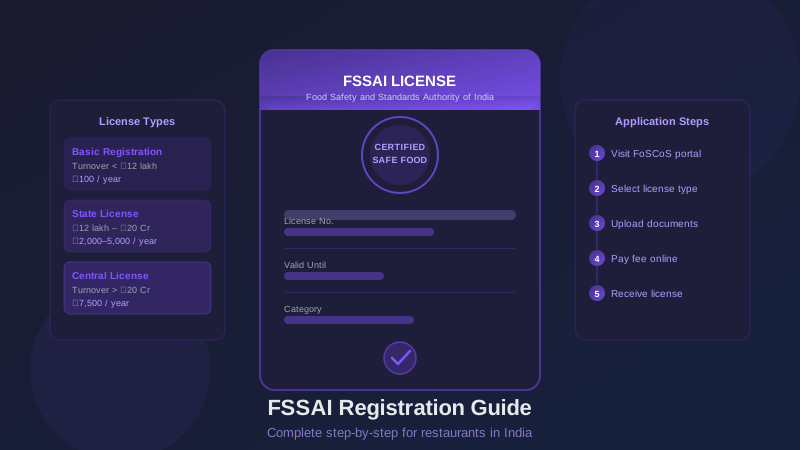
The type of FSSAI registration you need depends on your annual turnover. Here is a clear breakdown:
| Type | Annual Turnover | Annual Fee | Validity | Who Applies |
|---|---|---|---|---|
| Basic Registration | Up to ₹12 lakh | ₹100 | 1–5 years | Small eateries, home kitchens, petty retailers |
| State License | ₹12 lakh to ₹20 crore | ₹2,000–5,000 per year | 1–5 years | Most restaurants, cafés, cloud kitchens |
| Central License | Above ₹20 crore, or multi-state, or import/export | ₹7,500 per year | 1–5 years | Large chains, manufacturers, importers |
The vast majority of restaurants in India fall under the State License category. Even a new restaurant that expects to grow past ₹12 lakh quickly should apply for a State License from the outset — upgrading later adds friction and cost.
Documents Required for FSSAI Registration
The document list varies slightly between Basic, State, and Central licenses, but for a typical restaurant applying for a State License, you will need:
- Completed Form B (application form, available on FoSCoS portal)
- Photo ID of the applicant/proprietor/directors (Aadhaar, PAN, or Passport)
- Proof of premises — rent agreement, lease deed, or property ownership documents
- Proof of business entity — Partnership deed, MOA/AOA, or Certificate of Incorporation (for companies)
- List of food products or categories to be handled
- Food safety management plan or certificate
- NOC from the local municipality or panchayat
- Water test report (from a government-approved lab)
- Layout plan of the food premises
- Authority letter if applying through an authorised representative
Tip: Prepare digital scanned copies of all documents before starting the online application. The FoSCoS portal times out, and incomplete uploads are a common reason for delays.
Step-by-Step Application Process on FoSCoS Portal
Step 1: Visit the FoSCoS Portal
Go to foscos.fssai.gov.in — this is the unified portal for all FSSAI applications. Do not use third-party websites claiming to offer faster processing; the official portal is the only legitimate channel.
Step 2: Register as a New User
Create an account using your mobile number and email address. You will receive an OTP for verification. Once registered, log in to access the application dashboard.
Step 3: Select the Correct Application Type
Choose between Registration (Basic), State License, or Central License. If you are unsure, use the built-in eligibility checker on the portal — it walks you through turnover and business type questions to recommend the correct category.
Step 4: Fill in Form B
Provide all required business details: type of food business, nature of products, production capacity (if applicable), premises address, and contact information. For restaurants, the "Food Service Establishment" category applies.
Step 5: Upload Supporting Documents
Upload scanned copies of all required documents. Each file must be under 2 MB. The portal accepts PDF, JPG, and PNG formats.
Step 6: Pay the Fee
Choose the license validity period (1 to 5 years — multi-year licenses are more cost-effective). Pay online via net banking, debit card, or credit card. Save the payment receipt.
Step 7: Await Inspection (State License)
For State Licenses, a designated food safety officer may visit your premises to verify the application details. Ensure your kitchen and storage areas are in order before this inspection. The officer checks hygiene conditions, pest control measures, water quality, and safe food handling practices.
Step 8: Receive Your License
Once approved, the FSSAI license is issued digitally on the FoSCoS portal. Download and print it. Display it prominently at your premises — it is a legal requirement.
Timeline: Basic Registration is typically processed within 7 working days. State License can take 30–60 days depending on inspection scheduling and state-level workload. Apply at least 60 days before your planned launch.
Costs and Timeline Summary
For a typical new restaurant in a metro city applying for a 3-year State License:
- FSSAI State License fee: ₹6,000–15,000 (depending on the state and duration)
- Water testing report: ₹300–800
- Food safety management plan (if outsourced to a consultant): ₹2,000–10,000
- Total timeline: 30–60 days from application submission
Renewal Process
FSSAI licenses must be renewed before they expire. You can choose validity periods of 1 to 5 years at the time of application — choosing a longer period reduces paperwork frequency.
- Log into the FoSCoS portal 30–60 days before expiry
- Navigate to "Renewal Application" under your existing license
- Update any changed business details (new premises, new categories of food)
- Upload any updated documents (new lease agreement, updated business registration)
- Pay the renewal fee
- Await processing — renewal is typically faster than fresh applications
Warning: You can apply for renewal up to 30 days before expiry. If you miss the deadline, your license lapses and you must file a fresh application — a longer and more expensive process.
Penalties for Non-Compliance
Operating without an FSSAI license or with an expired one is a serious offence under the Food Safety and Standards Act, 2006. Penalties include:
- Operating without registration: Fine up to ₹5 lakh
- Selling unsafe or substandard food: Fine up to ₹5 lakh + potential imprisonment
- Misleading labels or advertisements: Fine up to ₹10 lakh
- Adulteration causing grievous injury: Imprisonment up to 7 years + fine up to ₹10 lakh
- Failure to display license: Fine up to ₹2 lakh
Beyond the legal penalties, an FSSAI violation that goes public — through a customer complaint or a surprise inspection — can devastate a restaurant's reputation on platforms like Zomato and Swiggy, where hygiene ratings are increasingly visible.
Common Mistakes Restaurant Owners Make
- Applying for the wrong category: Choosing Basic Registration when turnover will exceed ₹12 lakh forces an upgrade mid-operation — creating a compliance gap.
- Using the wrong address: The licensed premises must match where you are actually operating. Opening a second location requires a separate FSSAI registration.
- Forgetting to display the license: This is a separate, easily-avoided penalty. Frame and hang it behind the counter or at the entrance.
- Letting it lapse: Set a calendar reminder 60 days before expiry. This is one of those admin tasks that falls through the cracks until it is too late.
- Not updating after business changes: Adding a new category of food (say, starting to sell packaged items) or moving premises requires updating your registration. Operating outside the registered scope is a compliance violation.
Final Thoughts
FSSAI registration is one of the foundational steps in launching a food business in India — it is also one of the more straightforward compliance requirements when you approach it systematically. Prepare your documents in advance, apply early, and opt for a 3 or 5-year license to minimise renewal friction.
Once your compliance foundations are in place, you can focus on what actually grows your business: guest experience, operations, and marketing. That is where tools like ZillOut come in — helping you run reservations, billing, digital menus, and guest engagement from a single platform, so you can spend less time on admin and more time on the floor.
Frequently Asked Questions
What is FSSAI registration and who needs it?
FSSAI (Food Safety and Standards Authority of India) registration is a mandatory food safety licence for any business involved in food manufacturing, storage, distribution, or sale in India — including all restaurants, cloud kitchens, tiffin services, and food trucks. Operating without it can result in fines up to ₹5 lakh.
How long does FSSAI registration take in India?
Basic FSSAI registration (turnover below ₹12 lakh) typically takes 7–15 working days online. State licences can take 30–60 days. Central licences for large operations may take up to 60–90 days. Using a certified consultant can speed up approval by ensuring documents are complete from day one.
What documents are required for FSSAI registration?
For Basic registration you need: identity proof, address proof, proof of business premises (rent agreement/ownership), and a passport-size photo. State and Central licences additionally require a food safety management plan, NOC from the municipality, and water test reports.
What are the penalties for running a restaurant without FSSAI?
Under the Food Safety and Standards Act, operating without a valid FSSAI licence can attract penalties from ₹1 lakh to ₹5 lakh, and in serious cases, criminal prosecution. Zomato and Swiggy also require a valid FSSAI number before listing your restaurant on their platforms.
What is the difference between FSSAI registration, state licence, and central licence?
Basic Registration covers food businesses with an annual turnover below ₹12 lakh. State Licence is required for turnover between ₹12 lakh and ₹20 crore. Central Licence is mandatory for businesses with turnover above ₹20 crore, or for operations in multiple states. Most standalone restaurants and cloud kitchens fall under Basic or State Licence.